
Authentic Japanese Tea Sets: Handcrafted Teapots & Cups
For those seeking authentic Japanese teaware handcrafted by skilled artisans, this guide provides an easy-to-follow explanation of how to choose fine Japanese tea sets, focusing on Banko and Mino ware, while introducing a curated selection suited for various occasions—from daily family tea time to thoughtful gifts. Explore our collection to find a piece that seamlessly fits your lifestyle and gracefully elevates your daily tea ritual.
Table of contents
How to Choose the Right Japanese Tea Set

When selecting the right Japanese tea set, it is essential to consider both capacity and teaware shape based on the number of people and the setting in which you plan to enjoy your tea. Options range broadly—from large-capacity sets ideal for family gatherings, to pair sets designed for quiet moments with a partner, and compact sets that make thoughtful gifts. Keeping these key criteria in mind will help you discover a piece that seamlessly complements your daily life.
Choose by Teapot Capacity & Servings (ml/oz)

Teapot capacity should primarily be chosen based on how many servings you wish to pour at one time. For family tea time or hosting guests, a larger capacity of 350ml to 400ml (approx. 11.8–13.5 fl oz) is exceptionally practical, allowing you to serve everyone without frequent refilling. Conversely, for everyday tea enjoyed by couples or when savoring premium sencha or gyokuro in small, delicate infusions, a capacity around 320ml (approx. 10.8 fl oz) or a compact Hōhin is most suitable.
Choose by Teaware Shape & Style

Select a teapot shape according to ease of handling and the type of tea you wish to brew. Side-handle Kyusu, which pour effortlessly with a gentle turn of the wrist, and top-handle teapots (dobin), which stay cool to the touch even with boiling water, are well-suited for everyday use. Back-handle teapots offer versatile usability for both right- and left-handed pourers, while handleless Hōhin excel at concentrating the rich umami of high-grade teas brewed at lower temperatures.
The silhouette of the teacups also shapes the tea experience and table setting. Options include standard "Yunomi" for daily drinking, wide-brimmed "Kumidashi" that accentuate aroma, sleek "Ensui" and "Kiritate" that suit modern interiors, and refined "Kodai" that add a formal touch. Additionally, space-saving nested sets that allow cups to store neatly inside the teapot are widely favored for gifting.
Authentic Japanese Tea Sets for Home

Building upon the guidelines for ideal capacity and shape, we now introduce Japanese tea sets suited for daily home use and family gatherings. Crafted using traditional Japanese techniques, these teaware pieces not only enhance the natural flavors of tea but also bring a quiet harmony to your living space. Use this guide to find a set that aligns with your lifestyle and family size.
For Family & Small Gatherings (350ml – 400ml)

For family gatherings or hosting close friends, a larger-capacity tea set capable of brewing a generous portion at once is exceptionally useful. A teapot featuring a capacity of 350ml to 400ml (approx. 11.8–13.5 fl oz) saves you from frequent refilling, setting the tone for a relaxed tea moment. Together with the four included teacups, you can enjoy warm moments centered around fine Japanese tea.
Japanese Tea Set "Donguri" — Kyusu Teapot (400ml) with 4 Teacups

The "Donguri" is a 400ml (approx. 13.5 fl oz) tea set distinguished by its acorn-inspired silhouette and elegant brass handle. Inheriting the traditional techniques of Banko ware, the unglazed stoneware clay naturally tempers bitterness to bring out a smooth, rounded flavor. It is available in two colorways—a chic black and a serene white—that integrate seamlessly into modern living spaces.

The accompanying teacups can be chosen from two styles based on your preference: the traditional wide-mouthed "Kumidashi," designed to disperse the tea’s aroma, and the contemporary "F-Shape," which fits comfortably in your palm. Designed for ambidextrous pouring, this set allows you to serve tea effortlessly for everyday family use as well as for hosting guests.
Product Details
Set Includes: 1 Teapot (Kyusu), 4 Teacups
Color Variations: Black, White (2 colors)
Dimensions (Teapot):
W 16.0 cm (6.3 in) × D 10.0 cm (3.9 in) × H 12.5 cm (4.9 in)-
Dimensions (Teacups):
Kumidashi: Diameter 9.0 cm (3.5 in) × H 5.5 cm (2.2 in)
F-Shape: W 8.5 cm (3.3 in) × H 7.0 cm (2.8 in)
Capacity (Teapot): Recommended 400ml / Full 430ml (approx. 14.5 fl oz)
-
Capacity (Teacups):
Kumidashi: Recommended 80ml (approx. 2.7 fl oz) (approx. 5 cups per brew)
F-Shape: Recommended 150ml (approx. 5.1 fl oz) (approx. 2 cups per brew)
Material: Unglazed Stoneware (Banko ware / Interior glaze on teacups only)
Japanese Tea Set "Sencha" — Kyusu Teapot (350ml) with 4 Teacups

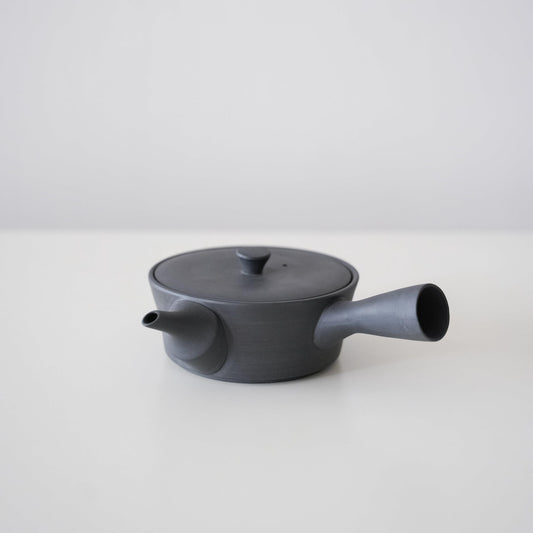
The "Sencha" is an authentic 350ml (approx. 11.8 fl oz) tea set characterized by its clean, linear aesthetic and striking matte black finish. Artisans meticulously hand-fit each lid through traditional precision grinding (suriawase), creating an airtight seal that extracts the full umami of the tea leaves. Unified in a single, sophisticated black tone, its serene presence harmonizes effortlessly with modern interior decor.

The matching teacups feature the "Kiritate" shape, noted for its crisp, straight-sided silhouette. The compact 50ml (approx. 1.7 fl oz) capacity is designed for savoring the rich umami of sencha or gyokuro down to the last drop. Combined with the unglazed texture that preserves delicate aromas, this set offers a refined tea experience to share with family and close friends.
Product Details
Set Includes: 1 Teapot (Kyusu), 4 Teacups
Color Variations: Black (1 color)
Dimensions (Teapot): W 15.0 cm (5.9 in) × D 17.5 cm (6.9 in) × H 8.0 cm (3.1 in)
Dimensions (Teacups): Diameter 7.0 cm (2.8 in) × H 4.5 cm (1.8 in)
Capacity (Teapot): Full 350ml (approx. 11.8 fl oz)
Capacity (Teacups): Recommended 50ml / Full 80ml (approx. 2.7 fl oz) (approx. 7 cups per brew)
Material: Unglazed Stoneware (Banko ware)
For Couples & Daily Tea (320ml & Specialized)

When sharing everyday tea moments with a partner or savoring your favorite tea leaves in depth, an easily manageable teapot around 320ml (approx. 10.8 fl oz) or a specialized teaware set is ideal. Tea brewed mindfully with an appropriate amount of water brings rich aromas and a pleasant sense of pause to daily life. We have curated a refined selection tailored to your intentions—from everyday tea enjoyed for two to artisanal gyokuro.
Japanese Tea Set "Sencha" — Kyusu Teapot (320ml) with 4 Teacups

The "Sencha 320" is a teaware set centered around a flat 320ml (approx. 10.8 fl oz) Kyusu distinguished by its shallow, wide silhouette. The broad base allows tea leaves to open fully, extracting the delicate aroma and umami inherent to sencha. Banko ware’s iron-rich clay tempers astringency, while a meticulously hand-fitted, airtight lid supports optimal tea extraction.

With this set, you can select your preferred teacup style to match your aesthetic. The modern matte black "Ensui" cups hold 100ml (approx. 3.4 fl oz), making them ideal for daily use. Alternatively, the white porcelain "Kodai" high-footed cups feature a crackle glaze (Kannyu) that absorbs tea over time, developing a unique character. Anchored by the calm presence of the black teapot, this set allows you to express your personal tea ritual.
Product Details
Set Includes: 1 Teapot (Kyusu), 4 Teacups
Color Variations: Teapot: Black (1 color) / Teacups: Choice between Ensui (Black) or Kodai (White)
Dimensions (Teapot): W 19.0 cm (7.5 in) × D 12.5 cm (4.9 in) × H 5.3 cm (2.1 in)
-
Dimensions (Teacups):
Ensui: W 8.0 cm (3.1 in) × H 6.2 cm (2.4 in)
Kodai: W 7.4 cm (2.9 in) × H 5.5 cm (2.2 in)
Capacity (Teapot): Full 320ml (approx. 10.8 fl oz)
-
Capacity (Teacups):
Ensui: Recommended 100ml / Full 170ml (approx. 5.7 fl oz) (approx. 3 cups per brew)
Kodai: Recommended 70ml / Full 100ml (approx. 3.4 fl oz) (approx. 4 cups per brew)
Material: Unglazed Stoneware (Banko ware) / Kodai teacups only: Porcelain
Japanese Hōhin Tea Set for Two

Crafted by Shinzan Kiln Yamatsu, a pottery with a proud heritage of Mino ware, this Hōhin tea set is designed for two. A Hōhin is a small, handleless teapot specifically suited for brewing gyokuro and premium sencha slowly at lower water temperatures. Holding the vessel gently in your palms to feel its warmth as you pour elevates your regular tea moment into a luxurious experience.

The teacups nest neatly inside the Hōhin for compact stacking, making it exceptionally convenient for storage or travel. Defined by a smooth porcelain texture and simple sculptural beauty, it is available in three serene shades: black, white, and pale blue. This set serves as a perfect choice for couples or part
Product Details
Set Includes: 1 Hōhin (handleless teapot), 2 Teacups
Color Variations: Black, White, Pale Blue (3 colors)
Dimensions (Hōhin): W 10.7 cm (4.2 in) × D 10.2 cm (4.0 in) × H 6.0 cm (2.4 in) (Weight: 230 g / 8.1 oz)
Dimensions (Teacups): Diameter 6.8 cm (2.7 in) × H 3.2 cm (1.3 in) (Weight: 40 g / 1.4 oz)
Capacity (Hōhin): 80ml (approx. 2.7 fl oz)
Capacity (Teacups): 45ml (approx. 1.5 fl oz)
Material: Porcelain (Mino ware)
Authentic Japanese Tea Set Gifts for Tea Lovers

For tea lovers or special anniversaries, a tea set filled with artisan dedication and thoughtful design makes an ideal gift. Combining traditional Japanese aesthetics with contemporary functionality, these pieces offer a relaxing retreat in your loved one’s daily routine. From compact, space-saving sets to items packaged in elegant gift boxes, our refined collection is well-suited for celebratory occasions.
Japanese Nested Tea Set

The "Japanese Nested Tea Set" is a compact teaware set featuring a clever nesting design where the teacups fit neatly inside the teapot. Available in two colorways—black and white—the handleless, Hōhin-style teapot is ideal for brewing gyokuro and high-grade sencha slowly at lower temperatures. Thanks to its space-saving storage, it is also wonderfully suited for outdoor tea moments, such as on a balcony or during a picnic.

The interior of the teapot is left unglazed, allowing the natural clay of Banko ware to temper astringency and bring out a smooth, rounded flavor. Conversely, the interior of the teacups is finished with a soft white glaze, allowing you to visually appreciate the vibrant color of the infused tea. Combining functionality with sculptural beauty, its minimalist aesthetic makes it a perfect casual gift for anyone looking to enjoy tea with ease.
Product Details
Set Includes: 1 Teapot (handleless), 2 Teacups (stackable/nesting)
Color Variations: Black, White (2 colors)
Dimensions (Teapot): W 11.5 cm (4.5 in) × D 9.0 cm (3.5 in) × H 6.0 cm (2.4 in)
Capacity (Teapot): 120ml (approx. 4.1 fl oz)
Material: Stoneware (Banko ware / Interior glaze on teacups only)
Japanese Teapot & Yunomi Teacups Set

Crafted by Shinzan Kiln Yamatsu, a pottery renowned for Mino ware, the "Japanese Teapot & Yunomi Teacups Set" is a modern teaware collection that won the prestigious Red Dot Design Award 2020 in Germany. Defined by a refined conical silhouette and a delicate brass handle, it brings a sophisticated accent to modern kitchens and living spaces. It comes in four serene colors—chic black, clean white, warm pink, and refreshing pale blue—allowing you to choose a shade that complements the recipient’s interior.

Featuring a generous 800ml (approx. 27.1 fl oz) teapot and two yunomi cups with tapered rims designed to concentrate aromatic tea, this set is ideal for sharing tea unhurriedly between two people. Arriving in an elegant gift box complete with an original catalog and tea strainer, it serves as a highly appreciated gift for weddings, housewarmings, or expressing gratitude to someone special.
Product Details
Set Includes: 1 Teapot, 2 Yunomi Teacups, 1 Brass Handle, 1 Tea Strainer, Catalog, Special Gift Box
Color Variations: Black, White, Pink, Pale Blue (4 colors)
Dimensions (Teapot): W 17.0 cm (6.7 in) × D 14.0 cm (5.5 in) × H 19.0 cm (7.5 in) (Weight: 510 g / 1.12 lbs)
Dimensions (Teacups): W 7.2 cm (2.8 in) × D 7.2 cm (2.8 in) × H 9.0 cm (3.5 in) (Weight: 130 g / 0.29 lbs)
Capacity (Teapot): 800ml (approx. 27.1 fl oz)
Capacity (Teacups): 220ml (approx. 7.4 fl oz)
Material: Porcelain (Mino ware)
Guide to Japanese Teaware Types

Beyond simply choosing a tea set you love, deepening your understanding of the origins and varieties of Japanese teaware will enrich your tea time even further. Traditional Japanese teaware is meticulously engineered to accommodate leaf characteristics, brewing temperatures, and user convenience. Recognizing the nuances among teapot shapes and teacup silhouettes allows you to appreciate vessels that perfectly align with your personal tea-drinking style.
Japanese Teapots: Types & Features

Japanese teapots (such as Kyusu and Hōhin) feature intricate details designed to optimize leaf expansion, water temperature, and the extraction of the very last drop. Combining distinct shapes with materials—from porous stoneware to taste-neutral porcelain—they unlock the full spectrum of tea's umami and aroma. Below is an overview of how handle placements and structural variations suit different brewing needs.
Kyusu (Side-handle, Back-handle, Top-handle)

Side-handle Kyusu (Yokode) represents the most iconic, uniquely Japanese design, featuring a handle positioned at a 90-degree angle to the spout. Designed to be held in the right hand with the thumb resting naturally over the lid knob, it pours effortlessly with a light tilt of the wrist. Because it allows easy one-handed pouring, it is widely suitable for everyday Japanese green teas such as sencha and Fukamushicha (deep-steamed green tea).

Back-handle Kyusu (Ushirode) shares a silhouette familiar to lovers of Western teapots and Chinese teaware, with the handle placed directly opposite the spout. Featuring a symmetrical structure, its universal design offers ease of use regardless of dominant hand preference. In addition to Japanese black tea, oolong, and herbal infusions, it is highly practical for left-handed tea brewers or those wishing to complement Western-inspired interior decor.

Top-handle teapots (Uwade), also known as dobin, feature an arched handle attached over the top of the body. Often crafted with a larger capacity, their design prevents heat from transferring to the handle even when filled with boiling water. They are well-suited for teas like hojicha, bancha, and genmaicha, which require scalding water to unleash their robust aromas, making them ideal for serving generous portions after meals or during larger family gatherings.
Hōhin

A Hōhin is a handleless teapot that has long been cherished in renowned high-grade tea regions such as Uji, Kyoto. By omitting the handle, the vessel remains compact and is specialized for concentrating the umami of fine tea leaves. Many feature delicate slits or small perforations carved directly inside the spout, allowing tea leaves to be strained naturally without the need for a metal mesh.
Because it lacks a handle, the hōhin is specifically designed for premium teas—such as gyokuro, high-grade sencha, and kabusecha—that are steeped slowly at lower temperatures between 50°C and 70°C. To pour, hold the upper rim directly where the clay remains cooler, gently securing the lid knob with your index finger. Note that pouring water at or above 80°C will make the vessel body too hot to hold, making it unsuitable for high-temperature teas like hojicha.
Japanese Teacups: Shapes & Design Styles

Beyond the teapot itself, the shape and design of the paired teacups significantly influence both the flavor of the tea and the atmosphere of your table setting. Options available in tea sets range widely—from traditional tall silhouettes and wide-brimmed guest cups to stylish, contemporary forms that elevate modern interiors. Below, we introduce the unique characteristics of each teacup style and the settings or preferences they best accommodate.
Yunomi (Standard Everyday Teacup)

Deep and cylindrical, the standard Yunomi is the most familiar and classic shape found in everyday tea sets. With a small surface area exposed to the air, it offers excellent heat retention, allowing you to enjoy hot tea over an extended period. When held, it cradles comfortably in your palms, gently transmitting its soothing warmth. This cup is recommended for anyone looking to enjoy generous portions of tea in casual daily settings—whether during everyday family gatherings or after-meal tea times.
Kumidashi (Wide-Brimmed Guest Cup)

Shallow with a mouth flared like a morning glory, the Kumidashi is a traditional shape featured primarily in tea sets designed for guests and formal occasions. Its wide brim allows heat to escape gently, bringing the tea down to a pleasant drinking temperature. Furthermore, an interior white glaze highlights the vibrant color of the brew. This style is ideal for hosts who wish to warmly entertain honored guests or for tea enthusiasts who want to savor the delicate aroma and umami of gyokuro and premium sencha at an unhurried pace.
Ensui (Modern Conical Shape)

Defined by its sharp conical silhouette, the Ensui brings a refined, modern impression to the entire tea set. It combines ergonomic ease—fitting naturally against your fingertips—with practical stackability for convenient storage. In addition, its subtly tapered rim funnels the tea's aroma directly toward your nose without letting it dissipate. This cup is recommended for those who appreciate designs that harmonize with contemporary living rooms or Western-style dining tables, adding a stylish touch to daily tea moments.
Kodai (Classic Raised-Foot Shape)

Featuring an elevated foot (Kodai) at its base, the Kodai cup is a sophisticated shape that projects an elegant, formal presence. Its porcelain surface is adorned with Kannyu (crackle glaze), an intricate webbing of fine lines that absorbs tea over time, allowing the vessel to develop a personal character unique to its owner. It is a fitting choice for those who wish to bring a dignified formality to hosting, or who appreciate traditional porcelain aesthetics and the evolving beauty of age.
Kiritate (Sleek Straight-Sided Shape)

Showcasing crisp, straight-sided vertical walls, the Kiritate is a cylindrical form stripped of all excess decoration. Its refined matte black texture and compact structure concentrate the tea's aroma, making it perfectly suited for mindfully savoring the rich umami of sencha or gyokuro drop by drop. This style is ideal for connoisseurs who value minimalist interiors, serene design aesthetics, and the exquisite quality of every brew.


What Makes a Japanese Tea Set Authentic?

What renders Japanese teaware truly authentic lies in the exceptional craftsmanship honed over centuries in each region, alongside a functional beauty built into every tool. A teapot or teacup is never merely a container; it is an artisanal craft, meticulously engineered by craftspeople who understand the unique properties of clay to enhance the flavor of tea. Here, we delve into the representative pottery regions supporting the teaware in this guide and the dedicated handiwork of the kilns upholding these traditions.
Banko Ware (Banko Yaki)

Centered in Yokkaichi, Mie Prefecture, Banko ware (Banko-yaki) is an officially designated traditional craft boasting a history of over 300 years since the mid-Edo period. Its signature creation, the unglazed purple clay teapot (Shidei Kyusu), is crafted by firing iron-rich clay without applying glaze. The iron content within the unglazed body naturally absorbs astringency from tea leaves, mellowing the brew to draw out its inherent, smooth umami.

Founded in 1913, Nankei Pottery is a kiln in Yokkaichi that has spent over a century crafting teapots and teacups in the Banko tradition. Managing every complex stage of production in-house—from raw clay selection to final touches—artisans perform careful hand-trimming, precise part assembly, and exacting lid-grinding (suriawase). Teaware brought to life through such seasoned mastery gains an ever-deeper character with years of use.
Nankei Pottery pursues functional design for brewing delicious tea paired with a simple elegance that quietly harmonizes with modern living spaces. While inheriting traditional techniques, their teaware is elevated to suit contemporary sensibilities, conveying the tactile warmth of clay whenever held in hand. It possesses the gentle charm to transform an ordinary daily tea moment into a deeply comforting retreat.
Mino Ware (Mino Yaki)

Produced in the Tono region of Gifu Prefecture, Mino ware (Mino-yaki) traces its roots back to Sue ware of the Heian period and stands as Japan's largest ceramic production center, accounting for the majority of the domestic tableware market. During the Azuchi-Momoyama period, it reached a golden age alongside the tea culture championed by Sen no Rikyu and others, giving rise to diverse styles such as Shino and Oribe. It carries a rich history of evolving fluidly with the aesthetic spirit of each era rather than remaining bound to a single style.

Established in 1868, Shinzan Kiln Yamatsu is a kiln with over 150 years of history located in Toki, Gifu—the heart of Mino ware. Guided by the philosophy of "firing care for your happiness," they craft vessels that seamlessly merge traditional handiwork with modern technology. Valuing teaware as a graceful supporting actor that elevates both the tea and the dining table, they offer beautifully refined white porcelain and ceramics that naturally settle into contemporary homes.
Teaware sets from Shinzan Kiln Yamatsu are defined by thoughtfully calculated functionality paired with elegant linear and curved silhouettes. Every detail is designed to refine daily gestures—from a tactile form that fits comfortably in hand at first touch to a rim sculpted to highlight subtle tea aromas. Infused with the dedication of a storied kiln, these pieces bring quiet joy and a warm sense of time.
Frequently Asked Questions (FAQ)

After exploring the history and craftsmanship behind authentic Japanese teaware, addressing common questions regarding selection and daily care offers helpful peace of mind. Understanding dishwasher compatibility, handling precautions, and standard set configurations in advance helps eliminate post-purchase uncertainty. Use this section as a practical guide to cherishing your favorite teaware for years to come.
Q: Are Japanese teapots and cups dishwasher safe?
A: Dishwasher compatibility for Japanese teaware depends on the materials and specific component specifications. While certain porcelain sets, such as the Mino ware Teapot & Yunomi set mentioned above, are dishwasher safe, attached brass handles and metal strainers must be removed beforehand. Conversely, unglazed stoneware and earthenware like Banko ware, teapots with wooden handles, and vessels featuring crackle glazes (Kannyu) should be hand-washed individually to prevent chipping, breakage, or alteration from water pressure and contact.
Porcelain Sets: While porcelain teapots and teacups are often dishwasher safe, removable accessories such as brass handles and metal tea strainers must always be detached and washed by hand to prevent damage or discoloration.
Earthenware & Stoneware (Unglazed, Banko ware, etc.): Hand-washing with a soft sponge is recommended, as dishwasher vibrations may cause items to collide with other dishes and chip, while high temperatures can compromise their natural texture.
Wooden Handles & Crackle Glaze (Kannyu) Finishes: Teaware with wooden handles or surface crackle glazes should not be placed in dishwashers or dryers, nor should they be left soaking in hot water for extended periods.
Q: How should I clean and care for my Japanese teapot and cups?
Daily care fundamentally involves promptly rinsing out spent tea leaves with warm or cold water after use and allowing the teaware to dry thoroughly. Because unglazed clay and delicate strainer sections are sensitive, avoiding harsh friction and detergent scent transfer will help preserve the raw clay's beautiful texture and hygiene over time.
Basic Washing & Drying: After rinsing away tea leaves with warm or cold water, thoroughly drain off excess moisture and allow the vessels to air-dry. Occasionally drying them completely in a well-ventilated area away from direct sunlight helps maintain optimal hygiene. When using detergent, opt for a mild neutral soap, avoiding abrasive sponges, metal scouring pads, and harsh cleansers.
Care for Strainers & Interiors: Integrated ceramic mesh filters and stainless steel strainers are delicate. Avoid forcefully pressing sponges into the interior or scrubbing aggressively with bare hands; instead, rinse them gently under running water.
Handling Tea Stains & Discoloration: If tea stains or discoloration become noticeable, soak the items overnight in a diluted solution of oxygen-based dish bleach, then rinse thoroughly with water to remove any residual odor before drying completely. Minor scuffs or dark marks on matte surfaces can sometimes be gently rubbed away using a standard pencil eraser.
Q: What does a traditional Japanese tea set include?
A: A traditional Japanese tea set typically consists of one primary vessel for brewing—such as a Kyusu or Hōhin—paired with multiple teacups (generally 2 to 4 pieces) tailored to the number of servings. You can choose the ideal set combination based on the type of tea enjoyed, the number of guests, and the intended occasion.
Kyusu or Hōhin Teapot: The central brewing vessel of the set. Teapots with handles (Kyusu) are included for everyday sencha or hojicha, whereas handleless teapots (Hōhin) are featured for slowly steeping gyokuro and premium sencha at lower water temperatures.
Teacups (Chawan): Supplied in sets of 2 (pairs) or 4 (for families or hosting guests). Cups are paired according to the set's design concept—ranging from deep, everyday Yunomi and wide-mouthed Kumidashi for hospitality and aroma, to sleek, conical Ensui forms.
Included Accessories: Depending on the product, sets may include specialized tea strainers, brass or wooden handles, and brand-original gift boxes, making them ready to present as thoughtful gifts or celebratory keepsakes.
Infused with traditional Japanese craftsmanship and artisan dedication, a fine tea set brings rich aromas and a sense of tranquility to your daily routine. Designed to be cherished for years to come, these pieces are ideal both for everyday moments at home and as a heartfelt gift for someone special. We invite you to explore our category page to discover our full lineup and product details.